

Recreational yellow perch catch limit for tidal waters and nontidal streams and rivers reduced to five

Angler Cayla Beam caught this yellow perch at Tuckahoe Creek on Dec. 6, 2025. For many anglers, winter fishing for yellow perch is an annual tradition. Photo by Justin Wilson
In response to six years of low recruitment, Maryland recreational anglers who fish this year for yellow perch (Perca flavescens) in tidal waters, and freshwater streams and rivers will be allowed to keep five yellow perch per person per day. The minimum size for recreational anglers remains 9 inches.
The Maryland Department of Natural Resources announced the change to the recreational daily catch limit, which was previously set at 10, by public notice at the beginning of January.
“Yellow perch face a lot of challenges, including habitat conditions, in order to successfully spawn. We believe this is an appropriate modification to improve the odds of better year classes,” said Carrie Kennedy, Director of Monitoring and Assessment for DNR’s Fishing and Boating Services.
Settling The Scales
DNR fisheries managers targeted a change to the recreational fishing allowance, given that the commercial sector’s Total Allowable Catch (TAC) is designed to decline when the population falls. Commercial fishermen have been allowed to harvest fewer yellow perch annually for several years, while recreational regulations were left unchanged.
The commercial TAC averaged about 36,000 pounds a year since 2009 and has declined from a high of 59,662 pounds in 2018 to a low of 14,184 lbs in 2024. The most recent change to the recreational fishery occurred in 2009, when the daily creel limit was increased from five fish to 10 fish. Although recreational harvest is likely within the target levels, it remains largely unknown because there are no current reliable recreational harvest estimates available.
The TAC is determined annually for the upper Chesapeake Bay, Patuxent, and Chester River fisheries, largely based on an annual stock assessment. The commercial fishery operates under a slot size range of 8.5 inches to 11 inches. All areas other than the upper Bay (areas north of Bay Bridge) and the Chester and Patuxen rivers are closed to commercial harvest.
Yellow Means Caution
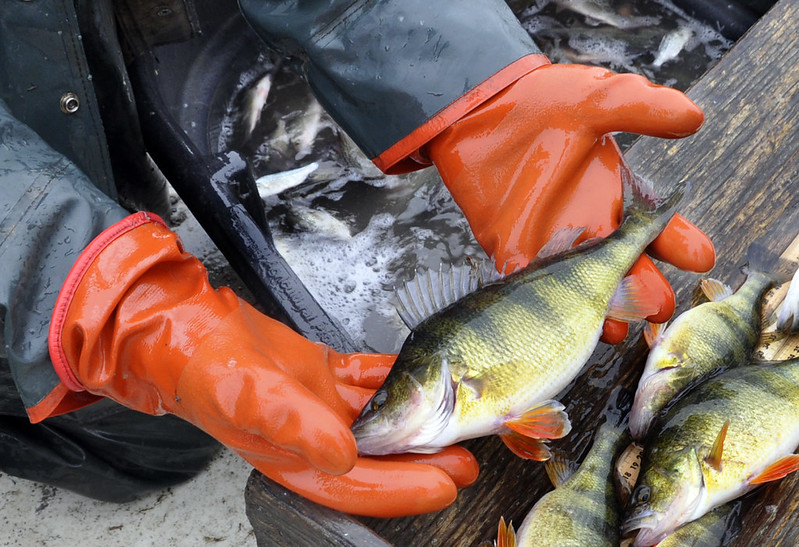
Biologists survey yellow perch. Maryland DNR photo
Since 2009, data from the upper Bay winter trawl survey show that the yellow perch population abundance in the upper Bay has declined by more than 50%, largely driven by below-average recruitment in recent years.
The annual Choptank River fyke net survey also tracks the abundance of yellow perch. Six fyke nets from Kingston Landing to Martinak State Park are fished for 4-6 weeks starting in the third week of February. This survey has been conducted since 1988, providing a robust data set. In recent years, yellow perch abundance in this survey has been at or near survey lows and has largely mirrored information coming out of the upper Bay survey.
The Choptank River does not have a commercial yellow perch fishery, and biologists do not believe fishing pressure from the recreational fishery is the main driver of the population contraction. Lower population levels are most likely due to factors other than fishing, such as poor reproduction, habitat degradation, predation, or disease. However, because of lower population levels, the revision to the creel limit will help reduce the harvest of larger females, preserving the spawning stock biomass. DNR Biologists hope this change will increase the chances of spawning success and juvenile recruitment throughout all tributaries of the Chesapeake Bay.
The Future of Yellow Perch
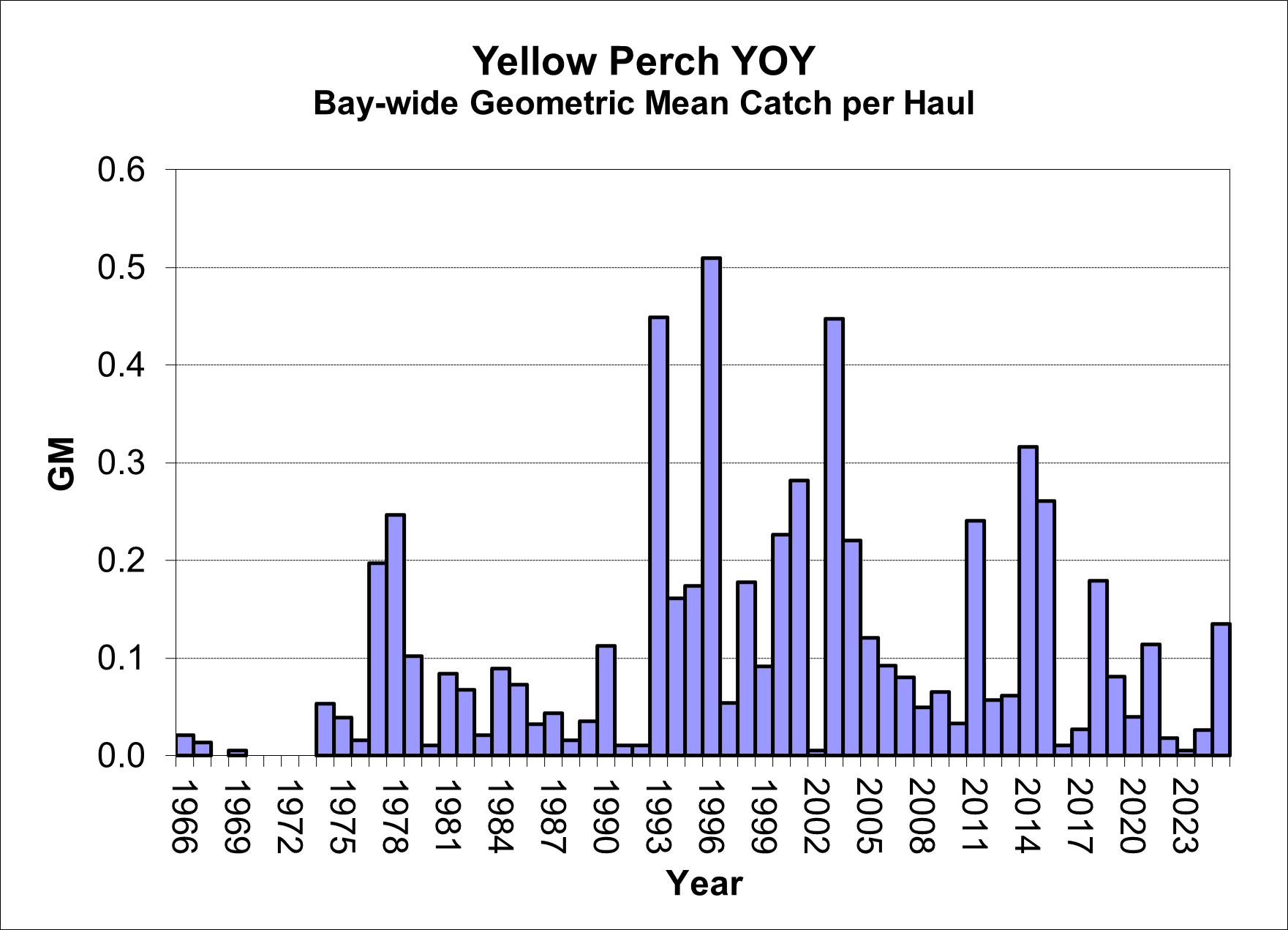
Chart of annual yellow perch abundance found in Maryland’s annual young-of-year survey.
On a positive note, the 2025 yellow perch young-of-year index produced from the Estuarine Juvenile Finfish Seine Survey was above average both Bay-wide and for the head of the Bay. The Bay-wide index was the highest since 2018.
Hopefully, the much-needed increase in young-of-year abundance seen in the seine survey will translate into higher catches of juveniles in the 2026 Upper Bay Winter Trawl Survey. This survey is a 6-week survey that runs from the beginning of January through the middle of February, with 20 sites that include two in the Susquehanna Flats, one in the Northeast River, four in the Elk River, three in the Sassafras River, and the remainder in the mainstem of the upper Bay.
A Maryland Tradition
This small, tasty freshwater fish, sporting two of the brilliant colors of the Maryland flag, is a seasonal fishery with a loyal following. Yellow perch range from South Carolina to Nova Scotia on the East Coast and can be found in all Maryland reservoirs, including Piney Run, Liberty, Loch Raven, and Prettyboy Reservoirs.
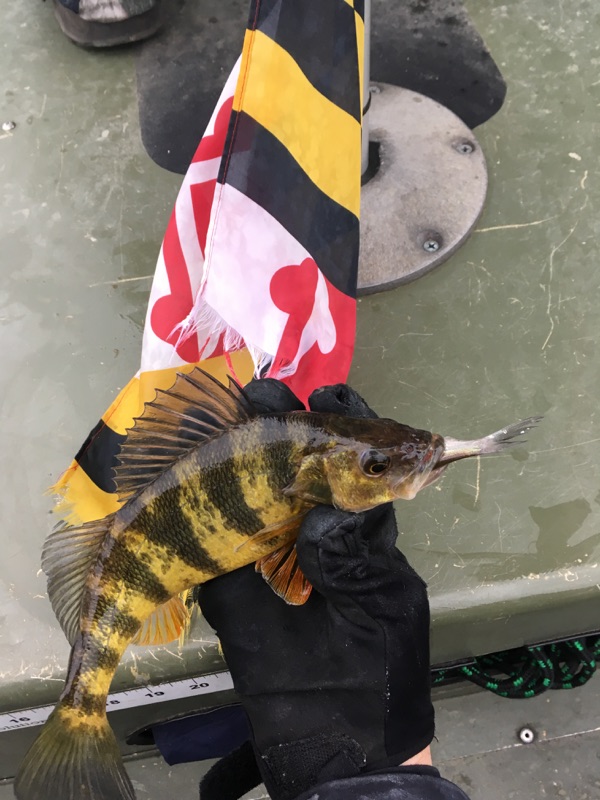
Yellow perch sport two of the colors of the Maryland flag. Photo courtesy of: John T. McMullen
However, In Maryland, yellow perch have adapted to the saltier water of the Chesapeake Bay and its major tributaries. The change to yellow perch fishing rules only applies to yellow perch in Bay, tributaries, and freshwater streams and rivers. It does not apply to reservoirs, lakes, ponds, impoundments, and waters upstream of them.
In late February, adult yellow perch in the Chesapeake Bay region go on their spawning run from the lower parts of the tributaries to the upper regions. As one of the first fish to arrive in rivers after the start of a new year, many anglers enjoy winter yellow perch fishing as an annual tradition. In 2025, angler Thomas Dembeck Jr. of Hydes caught a 2.3-pound, 16-inch yellow perch while fishing in the tidal waters of the lower Susquehanna and broke the Chesapeake division state record that had been held since 1979.
For those who fish for yellow perch, DNR recommends releasing full-bellied pre-spawn female perch and concentrating fishing on post-spawners, which can be found slightly downstream of the spawning areas, as an additional conservation measure.
The rules for catching yellow perch in freshwater, such as the popular Deep Creek Lake fishery, remain the same and can be reviewed in the Maryland guide to Fishing and Crabbing or on the eregulations website.
Fishing license, tackle, boat, and marine fuel purchases fund DNR’s fish conservation work. Fishing licenses can be purchased online through MD Outdoors or in person at license agent locations.
